OVD Egest Data
The is based on submissions made in accordance with the Operational Vessel Data (OVD) standard. The OVD data has been processed by DNV through validation,...
The OVD Egest Data is based on submissions made in accordance with the Operational Vessel Data (OVD) standard. The OVD data has been processed by DNV through validation, enrichment, data quality control and verification steps to support a variety of emissions use cases.
The goal is to provide customers with access to the complete datasets as available in Emissions Connect through the Veracity Data Workbench — including not only the data displayed in Emissions Connect, but also more detailed and comprehensive datasets intended to support deeper analysis and smooth integration with other services.
Four categories of datasets
- CII and ETS consumption and emissions Includes verified data on fuel consumption, emissions, and voyage-specific metrics focused on CII and ETS. Available at multiple levels of granularity:
- Voyage leg part
- Voyage leg
- Monthly
- Yearly and DCS reporting period
- Period (Annual, Monthly, Year to Month, Voyage, Commercial Period, etc)
- FuelEU The FuelEU Leg Emissions and FuelEU Leg Part Emissions datasets follow a structure similar to the CII and ETS datasets, while introducing additional columns and attributes specific to FuelEU Maritime compliance. These include:
- Actual and target GHGIE
- Compliance balance
- Penalty cost In addition, two dedicated datasets—FuelEU Period and FuelEU Period Consumption—provide detailed insights into FuelEU calculations and redistribution across various reporting periods.
- Data Quality Provides insights into data completeness, consistency, and the results of quality checks — including voyage leg verification (VLV) performed during the verification process and MRV and DCS regulatory compliance.
- Event-Level Data
With the ingested OVD data as basis, without any aggregation, enrichments have been added like MRV/ETS/FuelEU scope, type of voyage the event belongs to, data quality status of the event, calculated measures on lowest level, AIS based measures, etc. This dataset can be used to feed back to source systems to enrich the original datasets.
Overview of the available datasets on Veracity Data Workbench
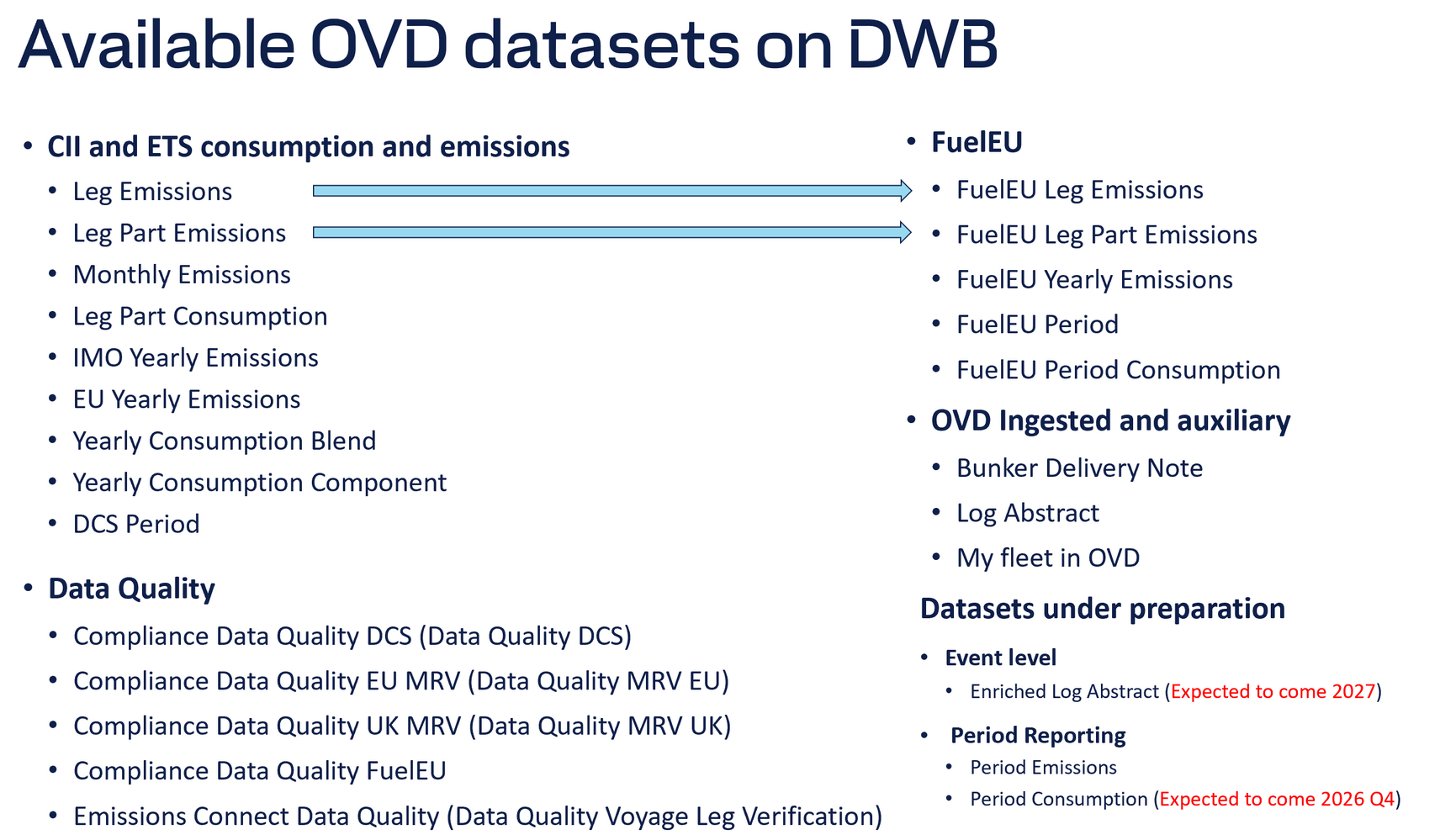
Additionally, ingested OVD data is available upon request through the Data Workbench. These datasets have undergone validation but do not include enrichment or data quality enhancements. Currently available datasets include Log Abstract and Bunker Delivery Note, with Commercial Period and Cargo Nomination to be added in future updates.
The overview below illustrates the available, upcoming, and planned datasets, along with their interrelationships.
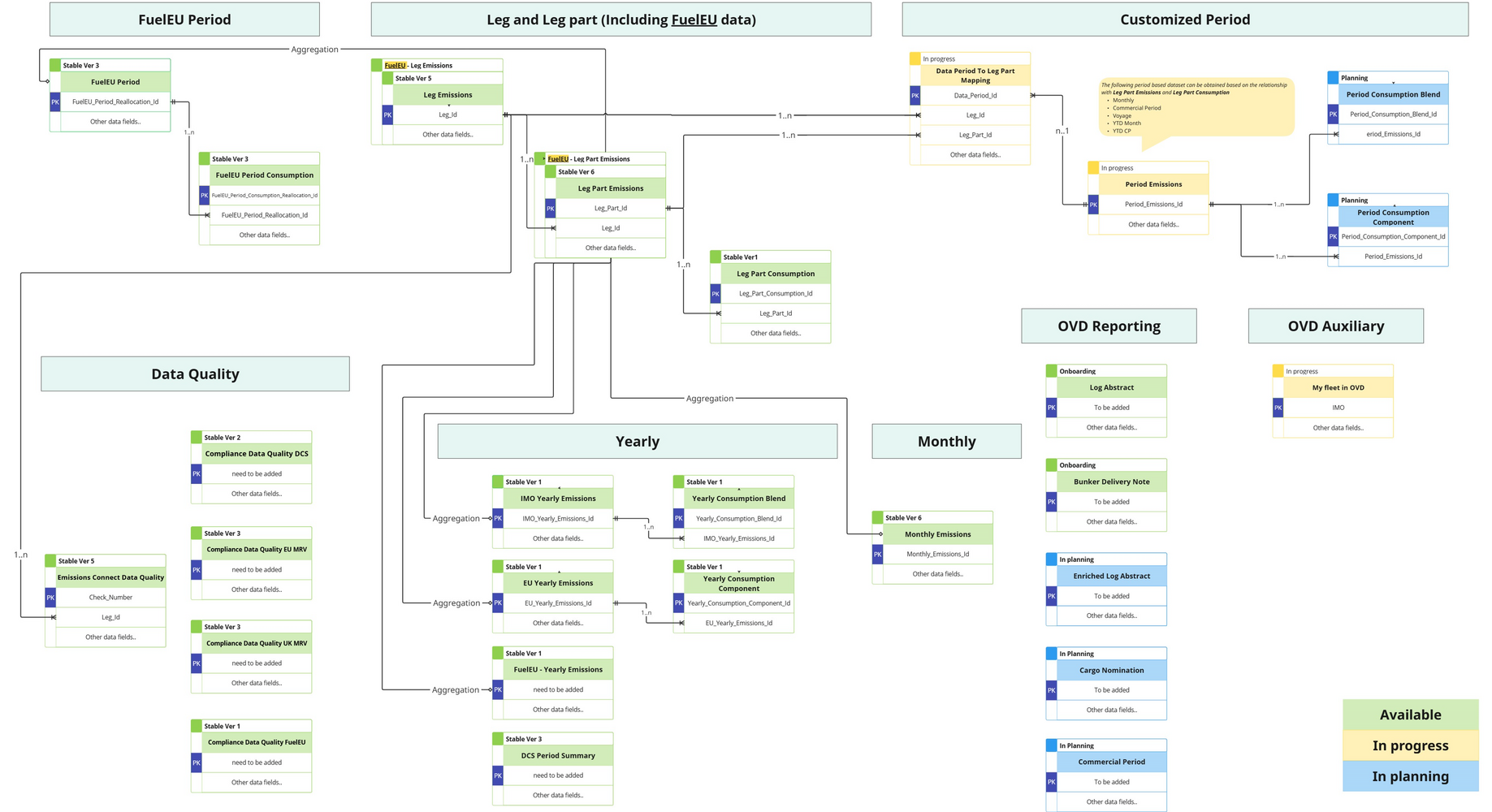
Dataset descriptions
Leg Emissions contains emissions data aggregated to the vessel and berth to berth voyage leg level. Each row represents the emissions data for a single vessel on a specific voyage leg. It also includes the leg CII score and rating.
FuelEU Leg Emissions contains emissions data aggregated to the vessel and berth to berth voyage leg level. Each row represents the emissions data for a single vessel on a specific voyage leg. It also includes the leg CII score and rating. It also includes key figures related to FuelEU.
Leg Part Emissions contains emissions data aggregated to the vessel and voyage leg part level. Each row represents the emissions data for a single vessel on a specific voyage leg part. A voyage leg may be divided into parts based on business requirements, such as the start of a new voyage or a new month. It also includes the leg CII score and rating.
FuelEU Leg Part Emissions contains emissions data aggregated to the vessel level for each year. Each row represents one vessel and its yearly data. For the current year, the data reflects year-to-date values. It also contains additional FuelEU columns in addition to this dataset. This is a temporary schema and will be replaced by new FuelEU schemas.
Leg Part Consumption contains fuel consumption and emissions data aggregated to vessel, voyage leg part, fuel type, and consumer type. Each row represents the total consumption of a specific fuel type for a single vessel and consumer type (e.g., main engine, auxiliary engine) within a voyage leg part.
Period Emissions contains vessel-level emissions and performance data aggregated by reporting periods, combining metrics from both IMO, EU and UK regulatory frameworks. The dataset includes indicators such as CII scores and ratings, EU MRV and EU ETS emissions, and FuelEU Maritime related fields. Each row represents a single vessel and its associated data for a specific reporting period, identified by the Data Period field. Reporting periods may correspond to a single calendar month (e.g., 201901 for January 2019) or a Year‑to‑Date (YTD) range covering multiple months (e.g., 20190103 for January through March 2019). Unless otherwise specified, values represent aggregated totals within the applicable regulatory scope.
FuelEU Period contains FuelEU data aggregated to the vessel and different FuelEU reporting periods (Annual, Monthly, Year to Month, Voyage, Commercial Period, etc.). Each row shows the FuelEU intensity, energy and related calculation results within a specific FuelEU period for a single vessel. Important Note: To ensure accurate analysis, only one FuelEU reporting period should be selected at a time, as aggregations are not additive across different period types.
FuelEU Period Consumption contains fuel consumption and emissions data aggregated to the vessel, different FuelEU reporting periods and different fuel types/GHGIE. Each row represents a consumption with its specific GHGIE and emissions data used by a single vessel during a specific FuelEU period. Important Note: To ensure accurate analysis, only one FuelEU reporting period should be selected at a time, as aggregations are not additive across different period types.
Monthly Emissions contains emissions data aggregated to the vessel level and month. Each row represents the total emissions for a single vessel in a specific month.
IMO Yearly Emissions contains emissions data aggregated at the vessel level for each calendar year. Each row represents one vessel and its corresponding annual data. The dataset also includes the vessel’s annual CII score and rating. For the current year, the data reflects year-to-date values.
EU Yearly Emissions contains emissions data aggregated at the vessel level for each reporting year. Each row represents one vessel and its corresponding annual totals. All unspecified elements in this schema represent total values within the scope of the EU, relevant for both MRV and ETS regulations. For the current year, the data reflects year-to-date values.
Yearly Consumption Blend contains fuel consumption and emissions data aggregated by year, vessel, fuel type or blend, consumer type, GHG intensity, and lower heating value (LHV). Each row represents the total consumption of a specific fuel type or blend, along with its associated GHG intensity and LHV, for a given vessel and consumer type (e.g., main engine, auxiliary engine) over the entire year.
Yearly Consumption Component contains fuel consumption and emissions data aggregated by year, vessel, fuel type, ETS CO₂ conversion factor, and consumer type. Each row represents the total consumption of a specific fuel type, along with its corresponding CO₂ conversion factor, for a given vessel and consumer type (e.g., main engine, auxiliary engine) over the entire year.
DCS Period contains aggregated emissions and fuel consumption data for each DCS reporting period. Each row corresponds to one vessel's reported emissions and fuel consumption during a specific period, categorized by the vessel's document of compliance holder and flag state. It also includes the verification status of the reported data. Note: A vessel may appear multiple times in the dataset.
Emissions Connect Data Quality (Data Quality Voyage Leg Verification) includes all checks applied during the Voyage Leg Verification (VLV) process, including those required for MRV and DCS compliance.
Compliance Data Quality EU MRV (Data Quality MRV EU) includes all checks according to MRV-EU requirements. Granularity depends on the type of check. It can be an event, a voyage leg, or year-to-date.
Compliance Data Quality UK MRV (Data Quality MRV UK) includes all checks according to MRV-UK requirements. Granularity depends on the type of check. It can be an event, a voyage leg, or year-to-date.
Compliance Data Quality FuelEU includes all checks according to FuelEU Maritime reporting requirements. Granularity depends on the type of check. It can be an event, a voyage leg, or year-to-date.
Compliance Data Quality DCS (Data Quality DCS) includes all checks according to DCS reporting requirements. Granularity depends on the type of check. It can be an event, or a reporting period.
Log Abstract contains raw data extracted from OVD Log Abstract Interface. This is data as it was delivered to OVD by the customer.
Bunker Delivery Note contains raw data extract from OVD Bunker Report. This is data as it was delivered to OVD by the customer.
My fleet in OVD provides an overview of vessels in the fleet, including identification details, multiple vessel classification schemes (Poseidon Principles, MARPOL, and EU), key technical characteristics, as well as operational attributes like delivery date, ice class, and aggregated indicators of data quality issues over different time periods.